Google Classroom
Google Classroom
GeoGebra
GeoGebra Classroom
Anmelden
Suche
Google Classroom
Google Classroom
GeoGebra
GeoGebra Classroom
Kapitel
Angle Relationships - Yr 7
Day 1 - Terminology and Naming Angles
Day 2 - Classifying Angles
Day 3 - Drawing and Measuring Angles
Day 4 - Adjacent Angles
Day 5 - Complementary and Supplementary Angles
Day 6 - Angles in a Revolution
Day 7 - Vertically Opposite Angles
Angle Relationships - Yr 7
Autor:
Ryan Smith
Inhaltsverzeichnis
Day 1 - Terminology and Naming Angles
Example and Definitions of a Point and Line
A Plane
Collinear Points Example and Definitions
Intersection Point and Concurrent Lines
Line segment example and Definition
Definition and example of a ray
Two rays to form an angle
Naming Angles
Parallel Lines
Perpendicular Lines
Markings on Geometric Figures
Day 2 - Classifying Angles
Acute Angles
Right Angles
Obtuse Angles
Straight Angles
Reflex Angle
Revolution Angle
Day 3 - Drawing and Measuring Angles
Measuring Angles with a protractor
Angle Guesser
Angle Creator - Sprinkler Question
Day 4 - Adjacent Angles
Adjacent Angles
Day 5 - Complementary and Supplementary Angles
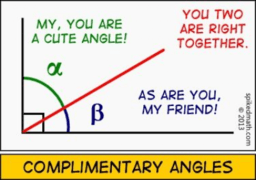
Complementary Angles
Complementary Angles Meaning
Supplementary Angles
Supplementary Angles Meaning
In summary...
How to do the practice
Day 6 - Angles in a Revolution
Simple Revolution
Three Ray Revolution - Angles at a point
How to do the practice
Day 7 - Vertically Opposite Angles
Vertically Opposite Angles
Perpendicular Lines
Weiter
Example and Definitions of a Point and Line
Neue Materialien
Graphing Basic and Compound Inequalities
Modifiable Right Triangular Prism
Rovnoběžnost rovin
Squaring a Rectangle (PST Version)
Midpoint Theorem (V2): Integer Solutions
Entdecke Materialien
Intersecting Chords and Tangents
Squirrel's Acorn Stash: One side of a linear equation
Untitled
Geogebra Tgs MTK
Tale of Two Triangles
Entdecke weitere Themen
Tangens
Quader
Rechteck
Quadratische Gleichungen
Mittelwerte